Last updated: July 2026 · Reviewed against A.O. Smith and Rheem service documentation
If you have hot water but it runs out too fast, the tank is heating — it just is not keeping up. The usual causes are a broken dip tube, sediment stealing tank capacity, a failed lower heating element (electric), a too-low thermostat setting, or simply a tank too small for your household. Here is how to find which one, from the free checks to the parts that need replacing.
Running Out Fast vs. No Hot Water
This guide is for when you get some hot water that runs cold quickly. If you get no hot water at all, that is a different problem — a failed element, tripped breaker, or out pilot; see water heater no hot water.
Cause 1: Broken Dip Tube
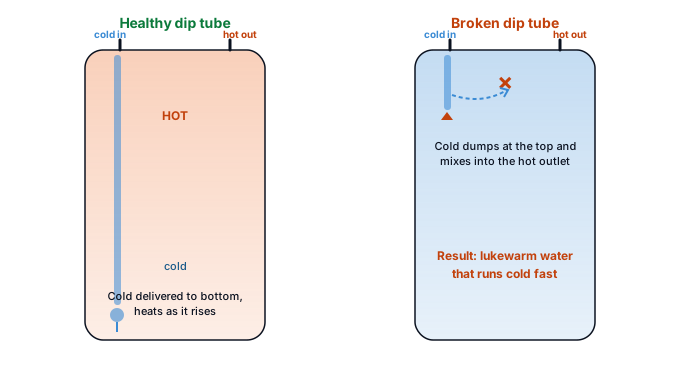
The dip tube carries incoming cold water to the bottom of the tank so it heats before rising. If it cracks or breaks (common on units 8+ years old), cold water dumps into the top and mixes with the hot water heading to your taps — so you get lukewarm water that runs cold fast. A replacement dip tube is cheap ($10–$20), though accessing it means some disassembly. Telltale sign: small white plastic bits in your faucet aerators.
Cause 2: Sediment Buildup
Sediment at the bottom of the tank takes up space that should hold hot water, so effective capacity shrinks and you run out sooner. It also insulates the burner. The fix is to flush the tank — if you have never done it and the tank is a few years old, this often restores lost capacity and is the first thing to try.
Cause 3: Failed Lower Element (Electric)
Electric heaters have two elements. The lower one does most of the heating; if it fails, the upper element alone heats only the top third of the tank — so you get a little hot water that runs cold quickly. Testing an element takes a multimeter; replacement elements are $15–$30. This is one of the most common causes of “not enough hot water” on electric units.
Cause 4: Thermostat Set Too Low
The simplest cause: the temperature is set too low. Try raising it toward 120°F — see how to turn up your water heater. If turning it up makes no difference, the problem is a component, not the setting.
Cause 5: Tank Too Small
If the heater is healthy but your household outgrew it — more people, longer showers, a new soaking tub — you may simply be exceeding the tank’s capacity. A 40-gallon tank serving a family of five will run out. Options: stagger hot water use, raise the temperature slightly (more usable hot water per gallon), or upsize to a larger tank or tankless for endless hot water.
FAQ
Why does my hot water run out so quickly?
The most common causes are a broken dip tube (cold water mixing into the hot), sediment reducing tank capacity, or a failed lower heating element on electric units. A too-low thermostat or an undersized tank for your household can also be the reason.
How do I know if my dip tube is broken?
Two signs: hot water that turns lukewarm and runs cold much faster than it used to, and small white or grayish plastic particles showing up in your faucet aerators and showerheads. Replacing the dip tube is an inexpensive fix.
Will flushing my water heater give me more hot water?
If sediment buildup has reduced your tank’s capacity, yes — flushing removes it and can restore lost hot water. It is the first, cheapest thing to try if your tank is a few years old and has never been flushed.
Sources: U.S. Department of Energy — Water Heating · manufacturer service documentation (A.O. Smith, Rheem, Bradford White).